Deploying a Full-Stack Online Restaurant Project on AWS
Overview
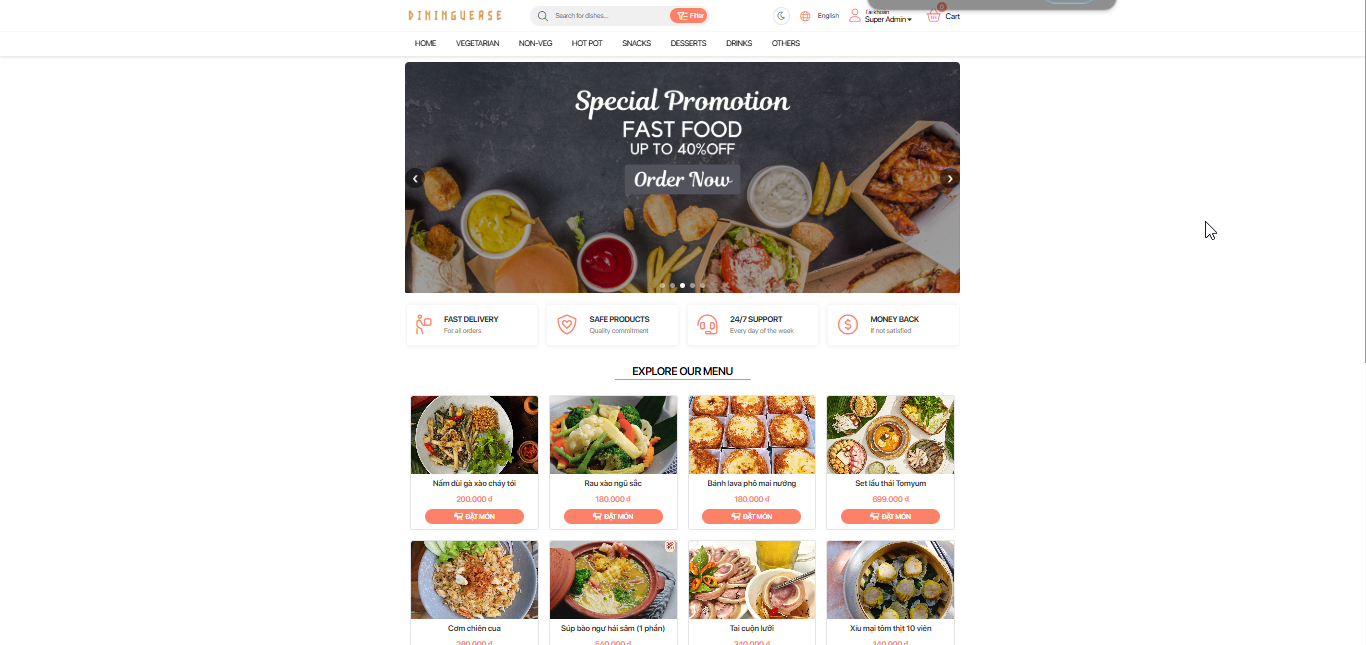
In this workshop, you will be guided step-by-step to deploy a complete online restaurant application on the Amazon Web Services (AWS) platform. The project includes a frontend built with HTML, CSS, and JavaScript, along with a powerful backend using Node.js (Express) and a MySQL database (RDS), creating a scalable, secure, and high-performance system.
Technologies and Services Used
ℹ️ The goal of the workshop is to build a professional cloud infrastructure that is fault-tolerant and auto-scaling to meet user traffic demands.
💡 The main AWS services used are:
- VPC (Virtual Private Cloud): Create a separate and secure network environment on AWS, including Public Subnets for resources that need internet access and Private Subnets to protect the database.
- EC2 (Elastic Compute Cloud): Where the Node.js backend application is deployed and run.
- AMI & Launch Templates: Create a “template” for the server, helping to automate the creation of new EC2 instances uniformly.
- Application Load Balancer (ALB): Distribute traffic to multiple EC2 instances, increasing the application’s availability and load-handling capacity.
- Auto Scaling Group (ASG): Automatically adjust the number of EC2 instances based on traffic, ensuring stable performance and cost optimization.
- RDS (Relational Database Service): Provide a fully managed MySQL database, simplifying installation, operation, and backup.
- S3 (Simple Storage Service): Store and serve the frontend’s static resources (HTML, CSS, JavaScript, images).
- CloudFront: A Content Delivery Network (CDN) service that helps speed up page load times for users globally and secures both the frontend and backend.
Architecture and Scope
ℹ️ The project is clearly separated into two parts: Frontend (user interface) and Backend (processing system), deployed independently but communicating closely with each other via API.
Backend (Server-side)
- The Node.js application is deployed on EC2 instances within an Auto Scaling Group.
- The Application Load Balancer will receive requests from users and forward them to the active EC2 instances.
- The RDS MySQL database is placed in a Private Subnet, only allowing access from EC2 instances to ensure maximum security.
- A CloudFront distribution is configured to point to the ALB, providing a layer of protection and acceleration for the API endpoints.
🔒 Frontend (Client-side)
- The entire frontend source code (static files) is uploaded to an S3 bucket.
- This S3 bucket is configured to function as a static website.
- Another CloudFront distribution is set up to serve content from the S3 bucket. The use of Origin Access Identity (OAI) ensures that users can only access the frontend through CloudFront, preventing direct access to the S3 bucket.
💡 Let’s start building a powerful and professional infrastructure for your application in the following sections!